
Doubts are emerging about Pakistan's role in mediating peace negotiations between the US and Iran, with suggestions that Islamabad's efforts are stalling and failing to secure a definitive response from the United States.

Pakistan Prime Minister Shehbaz Sharif on Thursday signed the historic peace deal between the United States and Iran as a guarantor; the agreement will see the immediate reopening of the Strait of Hormuz and the lifting of the US naval blockade.

US President Donald Trump has lauded a newly announced peace deal between the United States and Iran, predicting it will bring "peace and security" to West Asia and facilitate the reopening of the strategically vital Strait of Hormuz.

Pakistan Prime Minister Shehbaz Sharif announced that Pakistan would host the signing ceremony of a peace agreement between the US and Iran in Switzerland on June 19, calling it a "historic milestone" that ends a 107-day conflict and promises global economic stability.

US President Donald Trump announced a finalised peace deal between the US and Iran, set for signing on June 19 in Switzerland, with key figures like J D Vance, Steve Witkoff, and Jared Kushner from the US side, and Abbas Araghchi and Mohammad Bagher Ghalibaf representing Iran, alongside Pakistani mediators Field Marshal Asim Munir, Shehbaz Sharif, Ishaq Dar, and Mohsin Naqvi, playing crucial roles in the diplomatic breakthrough.

US Vice President J D Vance confirmed that peace talks with Iran are underway in Switzerland, with negotiators Steve Witkoff and Jared Kushner already present. Vance plans to join soon, expressing confidence in the US's strong negotiating position despite a delay caused by recent Israel-Lebanon firing.

Top leaders from the US, Iran, and Pakistan, along with other nations, have gathered in Switzerland for high-level talks aimed at restoring peace in West Asia. These negotiations follow a recently signed Memorandum of Understanding between the US and Iran, initiating a 60-day window for a deal. Discussions focus on Iran's nuclear programme and the fragile interim peace deal, amidst renewed tensions and the fluctuating status of the Strait of Hormuz.

President Vladimir Putin has declared Russia's willingness to finalise a peace agreement with Ukraine based on US President Donald Trump's Anchorage proposals, provided Kyiv accepts necessary compromises.

US Secretary of State Marco Rubio on Friday (local time) announced a US-mediated framework agreement between Israel and Lebanon aimed at achieving "lasting peace and security".

Pakistan and Qatar have successfully mediated separate meetings between US and Iranian negotiators in Doha, reporting positive progress on a Memorandum of Understanding aimed at West Asian peace. Further discussions are planned after the funeral of former Iranian Supreme Leader Ayatollah Ali Khamenei.
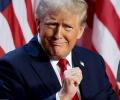
US President Donald Trump announced that a deal to end the war with Iran would be signed on Sunday, with the strategic Strait of Hormuz immediately becoming 'open to all'. This follows indications from Pakistan that negotiations were in their final stages, though Iran has yet to comment on the timeline.

Indian benchmark stock indices, Sensex and Nifty, extended their winning streak for a third consecutive day, driven by positive global market trends and a significant softening of crude oil prices following a peace deal between the US and Iran.
Pakistan Prime Minister Shehbaz Sharif announced that a US-Iran peace deal is on the verge of finalisation, potentially within the next 24 hours, marking a significant diplomatic breakthrough after months of intense negotiations.

Iran's Deputy Foreign Minister Kazem Gharibabadi confirmed a peace deal with the United States, stating that Tehran will enter a 60-day negotiation period only after verifying Washington's commitments to ending hostilities, lifting the blockade, and releasing Iranian assets.

A nearly 72-hour standoff at the Nagarasu gurdwara in Uttarakhand's Rudraprayag ended on Tuesday evening as a group of Nihangs holed up at the shrine vacated the premises after talks with a delegation from Punjab, officials said.

Pakistan Prime Minister Shehbaz Sharif on Friday said that the US and Iran have agreed on the text of a peace deal, kindling hope of a diplomatic breakthrough in the region.

US President Donald Trump and Pakistan Prime Minister Shehbaz Sharif have announced a landmark peace deal between the US and Iran, which includes the crucial reopening of the strategically important Strait of Hormuz and the immediate cessation of military operations in Lebanon.

Israel has strongly condemned Pakistan Defence Minister Khawaja Asif's "outrageous" remarks calling for Israel's annihilation and labelling it "evil" and a "curse for humanity", raising doubts about Pakistan's role as a "neutral arbiter" for peace.

US President Donald Trump on Friday said that the 'ceasefire' that he got done between India and Pakistan was a favour to their army chief Asim Munir and Prime Minister Shehbaz Sharif.

Iran has denied sending a delegation to Islamabad for peace talks with the United States, contradicting Pakistan's claims of mediating the negotiations. The denial highlights a lack of confidence in Pakistan's ability to ensure security for high-level participants and underscores the fragile nature of diplomatic efforts between the US and Iran.

Former US President Donald Trump reiterated his claim of mediating the India-Pakistan conflict, stating that 11 jets were shot down during the May 2023 hostilities. He also suggested the conflict could have escalated to a nuclear level and claimed credit for averting a major catastrophe, a claim consistently denied by India which maintains no third-party intervention occurred.

US Secretary of State Marco Rubio met with Pakistan's Foreign Minister Ishaq Dar amid American demand that countries mediating the peace talks with Iran join the Abraham Accords and establish diplomatic and economic ties with Israel.
Pakistan Prime Minister Shehbaz Sharif clarified that the recent Memorandum of Understanding (MoU) signed between the US and Iran does not include provisions regarding Tehran's ballistic missile programme. This statement followed talks with Iranian President Masoud Pezeshkian, with Sharif emphasising Iran's right to its defence capabilities and Pakistan's role as a mediator in the US-Iran peace process.

The US and Iran have agreed on a roadmap aimed at reaching a final agreement within 60 days after hours-long talks at the Swiss resort of Burgenstock, mediators Qatar and Pakistan said on Monday, describing the progress as "encouraging."
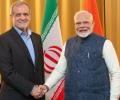
Prime Minister Narendra Modi held a telephonic conversation with Iranian President Masoud Pezeshkian, discussing recent developments in West Asia and reiterating India's emphasis on the importance of freedom of navigation in the Strait of Hormuz. Modi welcomed the recent peace understanding between the US and Iran, stressing dialogue and diplomacy for regional stability. India will also send representatives to the burial ceremonies of Iran's late Supreme Leader.
The United States and Iran are engaged in indirect talks aimed at developing a framework for a possible agreement, according to Iran's ISNA News Agency. Intensive mediation efforts are underway, but it remains uncertain whether a final agreement is within reach.

Pakistan capital Islamabad is emerging as the leading venue for the next round of technical negotiations between the US and Iran, a media report said Sunday.

China's week-long mediation between Pakistan and Afghanistan concludes without a formal agreement, though Beijing claims progress in exploring solutions to resolve their differences.

US Special Envoy Steve Witkoff and Iranian Foreign Minister Abbas Araghchi are reportedly heading to Switzerland for a new round of US-Iran negotiations, following a recently announced memorandum of understanding to end hostilities in West Asia and a ceasefire between Israel and Hezbollah.

The United States' historical strategic alignment with Pakistan, dating back to the Cold War, has consistently aimed to create a political and military parity with India, despite India's significantly larger size and resources. This long-standing relationship continues to influence regional dynamics, particularly in West Asia and the Indo-Pacific.

US Vice President JD Vance on Sunday generated significant online traction after making a light-hearted reference to two "very, very important" Indian and Pakistani people in his life - his wife Usha Vance and Pakistani Army chief Asim Munir, on the sidelines of the US-Iran diplomatic deliberations in Switzerland.

A Pakistani delegation, led by Army Chief Field Marshal Asim Munir, has arrived in Tehran to mediate the ongoing conflict between the US and Iran, following initial talks in Islamabad.

India has expressed firm opposition to attacks on merchant shipping amidst the ongoing Iran conflict, revealing that several Indian nationals have died or are missing due to these incidents. The nation also called for restraint, de-escalation, and prioritising civilian safety in the region.

Pakistani Prime Minister Shehbaz Sharif is actively engaged in diplomatic efforts to de-escalate tensions in West Asia, offering to host talks between the US and Iran and engaging with regional leaders to promote peace and stability.

The Gulf countries on Monday welcomed a peace deal reached between the US and Iran to end their conflict and called for protection of maritime routes and freedom of international navigation, including the uninterrupted flow of traffic through the Strait of Hormuz.

Pakistan Prime Minister Shehbaz Sharif expressed 'forever grateful' to US President Donald Trump for his 'timely' intervention in securing a ceasefire with India following a military conflict last year, a claim India has consistently rejected.

Russian President Vladimir Putin has offered his support to help bring peace to West Asia, praising the Iranian people for their resilience. This comes as Iran seeks to resolve the conflict with the US, following discussions with Pakistani and Omani leadership.

Uncertainty surrounds the planned second round of peace talks between the US and Iran in Islamabad, as both sides engage in brinkmanship. Despite Pakistan's security preparations, Iran has yet to confirm its attendance, citing a lack of seriousness from the US in pursuing diplomacy and violations of the ceasefire.

The US and Iranian delegations left Pakistan after failing to reach an agreement in historic talks aimed at resolving the West Asia conflict and stabilising global energy markets.
Pakistan has backed China's claim that Beijing played a role in defusing tension with India during Operation Sindoor, calling it 'diplomacy for peace' that was part of international efforts.
